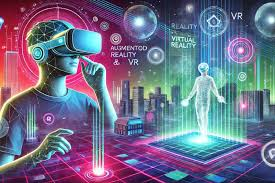
Technology continues to reshape how humans interact with information, entertainment, and even each other. Among the most transformative innovations are Augmented Reality (AR) and Virtual Reality (VR). While both technologies enhance human experiences, they do so in fundamentally different ways. AR overlays digital information onto the real world, while VR immerses users in a fully digital environment. Together, these technologies are revolutionizing industries such as gaming, healthcare, education, retail, and training, offering experiences that were once the realm of science fiction.
Understanding AR and VR
Augmented Reality (AR)
Augmented Reality refers to technology that overlays digital elements—such as images, videos, or 3D models—onto the real-world environment in real time. AR enhances perception rather than replacing reality, allowing users to interact with digital content while remaining aware of their physical surroundings.
Popular examples of AR include:
- AR apps on smartphones like Pokémon GO, which superimpose virtual creatures onto real-world landscapes.
- AR navigation tools, projecting directions directly onto the user’s view through AR glasses or mobile devices.
- AR in shopping, allowing customers to visualize furniture, clothing, or accessories in their environment before purchase.
Virtual Reality (VR)
Virtual Reality, on the other hand, creates a fully immersive digital environment, replacing the real world with a simulated one. Users typically interact with VR through head-mounted displays (HMDs) and sometimes haptic devices that provide tactile feedback. VR immerses users completely, making them feel as though they are inside a digital space.
Popular VR applications include:
- VR gaming, such as Beat Saber or Half-Life: Alyx, providing fully interactive environments.
- VR training simulations, used by pilots, surgeons, and military personnel to practice safely in realistic scenarios.
- VR social platforms, enabling virtual meetups and conferences.
Differences Between AR and VR
| Feature | Augmented Reality (AR) | Virtual Reality (VR) |
|---|---|---|
| Environment | Enhances the real world | Fully replaces the real world |
| Hardware Requirements | Smartphones, tablets, AR glasses | VR headsets, sensors, haptic devices |
| User Experience | Semi-immersive, interactive overlay | Fully immersive, interactive simulation |
| Applications | Navigation, retail, education, healthcare | Gaming, training, simulations, social VR |
While AR keeps users connected to reality, VR immerses them completely in a digital universe. Both approaches have unique advantages and applications depending on the desired experience.
Applications of AR and VR
1. Gaming and Entertainment
The gaming industry was among the first to adopt AR and VR on a large scale. VR provides fully immersive gameplay, transporting players into fantastical worlds where they can interact with the environment in real time. AR, on the other hand, merges gaming with the real world, creating hybrid experiences that blend physical and digital interaction.
Beyond gaming, VR is being used for virtual concerts, 360-degree films, and interactive storytelling, providing audiences with deeply engaging entertainment experiences. AR enhances theme park rides, museums, and live performances with digital overlays that enrich the experience.
2. Education and Training
AR and VR are transforming education by making learning interactive and experiential. VR allows students to explore historical events, distant planets, or complex scientific processes in a fully immersive environment. For example, medical students can perform virtual surgeries without risk to patients, while engineering students can manipulate complex machinery in a virtual lab.
AR supplements traditional classrooms by overlaying diagrams, 3D models, or translations onto textbooks, providing visual and interactive support for learning. Language learning, anatomy, and STEM education benefit particularly from AR applications.
3. Healthcare and Medicine
AR and VR are revolutionizing healthcare in multiple ways:
- VR therapy helps patients manage pain, anxiety, or phobias through immersive simulations.
- AR-assisted surgery overlays critical information, such as patient anatomy, directly onto the surgeon’s field of view, increasing precision and reducing risks.
- Medical training uses VR to simulate surgeries, emergency response, or complex procedures, allowing practitioners to practice repeatedly in safe conditions.
These technologies enhance patient care, reduce errors, and improve medical education outcomes.
4. Retail and E-Commerce
Retailers are leveraging AR to provide interactive shopping experiences. Customers can virtually try on clothing, makeup, or accessories before making purchases. Furniture retailers allow users to visualize items in their homes using AR apps, reducing uncertainty and improving satisfaction.
VR enables virtual stores and showrooms, allowing shoppers to browse and interact with products without leaving their homes. These immersive shopping experiences increase engagement and can lead to higher conversion rates.
5. Industrial and Workplace Applications
VR is used in industrial training, simulating machinery operations, factory workflows, and hazardous environments without risk. AR assists maintenance workers by overlaying instructions, diagrams, or real-time data on equipment, improving efficiency and reducing errors.
Fields such as architecture and construction use VR to create virtual walkthroughs of buildings, while AR provides on-site guidance during assembly, inspection, or repair processes.
6. Military and Defense
AR and VR provide advanced training tools for military personnel. VR simulations prepare soldiers for combat scenarios in a safe, controlled environment, while AR overlays tactical information on real-world terrains. These technologies enhance situational awareness, strategic planning, and mission preparedness.
7. Tourism and Real Estate
VR allows virtual tours of hotels, landmarks, or properties, enabling travelers or buyers to explore locations remotely. AR enhances real-world tourism by providing interactive guides, historical overlays, and navigation assistance. Together, AR and VR create richer, more immersive travel experiences.
Benefits of AR and VR
The adoption of AR and VR brings numerous benefits:
- Enhanced Engagement: Immersive experiences capture attention and improve retention.
- Practical Training: VR provides safe, risk-free environments for learning complex tasks.
- Personalization: AR allows tailored experiences based on user preferences and context.
- Innovation Across Industries: From healthcare to retail, AR and VR unlock new possibilities for creativity and efficiency.
- Accessibility: Virtual experiences make learning, travel, and entertainment accessible to people who cannot participate physically.
Challenges and Limitations
Despite their transformative potential, AR and VR face challenges:
- High Cost: Quality VR headsets and AR devices remain expensive for mass adoption.
- Technical Limitations: Motion sickness, low resolution, and hardware constraints can limit user experience.
- Content Development: Creating high-quality, interactive AR/VR content requires specialized skills and resources.
- Privacy and Security: AR devices that collect real-world data raise privacy concerns, while VR platforms can be vulnerable to cyber threats.
- Digital Divide: Access to AR/VR technology may be limited in developing regions, exacerbating inequalities.
Addressing these challenges requires advancements in hardware, software, accessibility, and ethical frameworks for safe and responsible usage.
The Future of AR and VR
The future of AR and VR promises even deeper integration into daily life. Emerging trends include:
- AR Glasses: Lightweight, stylish AR glasses may replace smartphones as the primary interface for digital information.
- Social VR Platforms: Virtual meeting spaces could become standard for work, education, and social interaction.
- AI Integration: AI-powered AR/VR experiences will adapt in real time, providing personalized, intelligent interactions.
- Haptic Feedback and Sensory VR: Advanced devices will simulate touch, temperature, and motion, making virtual experiences more lifelike.
- Mixed Reality (MR): The convergence of AR and VR will create hybrid experiences that seamlessly blend the physical and digital worlds.
These developments will make AR and VR more immersive, accessible, and integral to work, learning, and entertainment.
Conclusion
Augmented Reality (AR) and Virtual Reality (VR) are more than just technological novelties—they are reshaping how humans interact with the world. From gaming and entertainment to healthcare, education, and industry, these technologies enhance engage